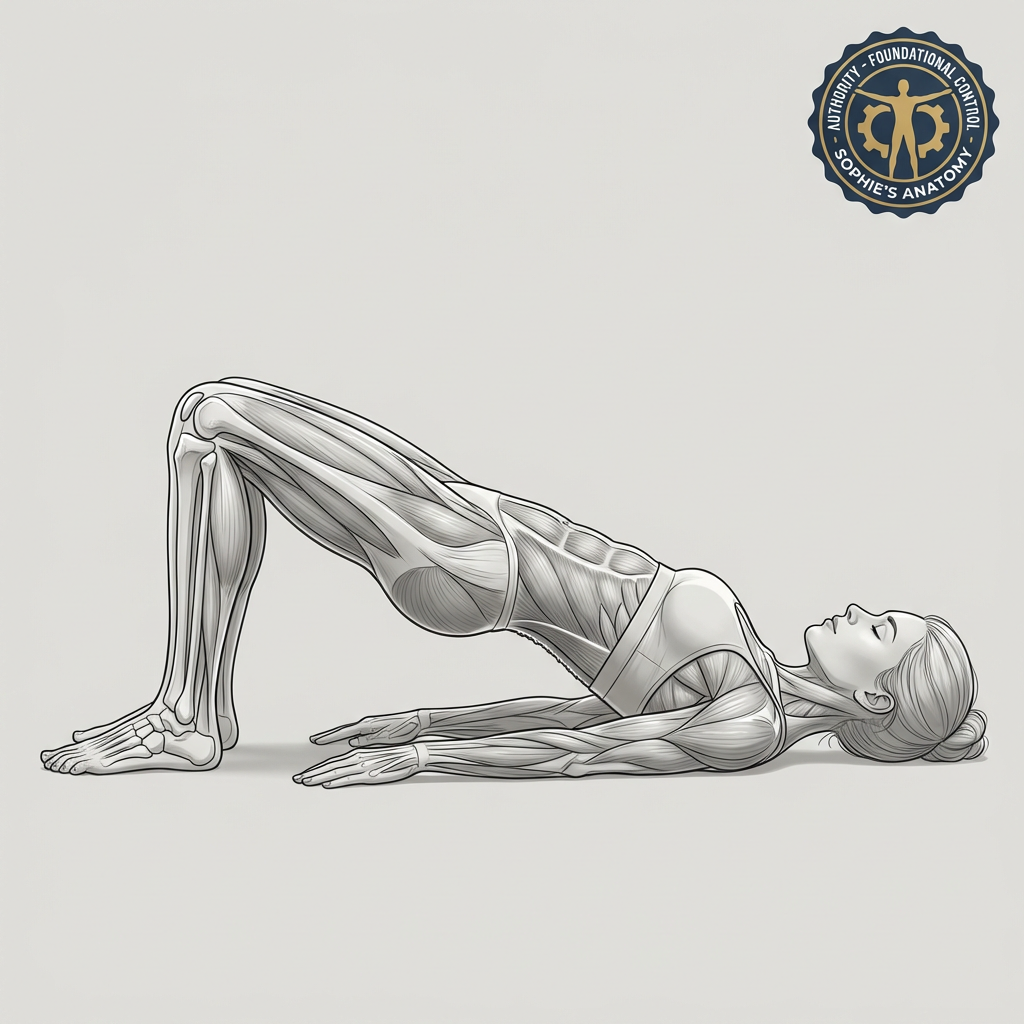
Supine Stable Pelvic Bridge
Static stretching of an irritated nerve adds tension to tissue that needs decompression and stability. Sophie's protocol uses neural gliding, lumbar offloading, and progressive core control — the evidence-supported sequence for sciatic recovery.
I'd been living with sciatica for 18 months. Stretching helped temporarily but it always came back. This was finally about decompressing the nerve, not pulling on it. Pain frequency reduced by 80%.
Clinical Evidence: Pilates reduces lower back pain by up to 72% (Asik et al, 2025 RCT). NICE recommends Pilates as a first-line treatment for chronic lower back pain before medication.
Many people with sciatica have related compensation patterns elsewhere in the spine. These comparisons walk through how Sophie's clinical Pilates protocols differ from generic stretching for each condition.
Browse the full library of evidence-based Pilates protocols for 35 conditions across back pain, sport-specific training, and post-surgical recovery.
Sciatica isn't a diagnosis — it's a symptom. The shooting pain that runs from your lower back through the glute and down the leg is a signal that the sciatic nerve is being compressed somewhere along its path. The two most common culprits are the lumbar spine (where a disc, joint, or ligament narrows the nerve's exit) and the piriformis muscle (which sits directly on top of the nerve in the deep glute). Generic stretching ignores this distinction — which is why so many sciatica sufferers stretch for months without lasting relief, or feel worse after each session.
The most common stretches recommended for sciatica — knee-to-chest, figure-four, seated forward fold — all share one feature: they put the lumbar spine into flexion. For a person whose sciatica is driven by a disc protrusion or a flexion-sensitive lumbar joint, this is exactly the position that increases nerve compression. The stretch feels productive in the moment because the nerve glides briefly, but the underlying compression worsens. Symptoms return within hours, often more intensely than before.
Even when the source is piriformis tightness rather than the spine, static stretching has a second problem: it doesn't address why the piriformis became overactive in the first place. The piriformis is a small deep-glute muscle that fires hard when the larger glute muscles (gluteus maximus, gluteus medius) are weak or inhibited. Stretching the overworked piriformis without strengthening the muscles that should be doing its job sets up a cycle — release, return, release, return — that never closes.
There is also a neurological dimension. A compressed nerve develops what physiotherapists call "protective tension" — the nervous system holds the surrounding muscles in low-grade contraction to limit movement near the irritated site. Aggressive stretching is read by the nervous system as a threat, which increases this protective tension rather than releasing it. The result is the familiar pattern of stretching harder for less return.
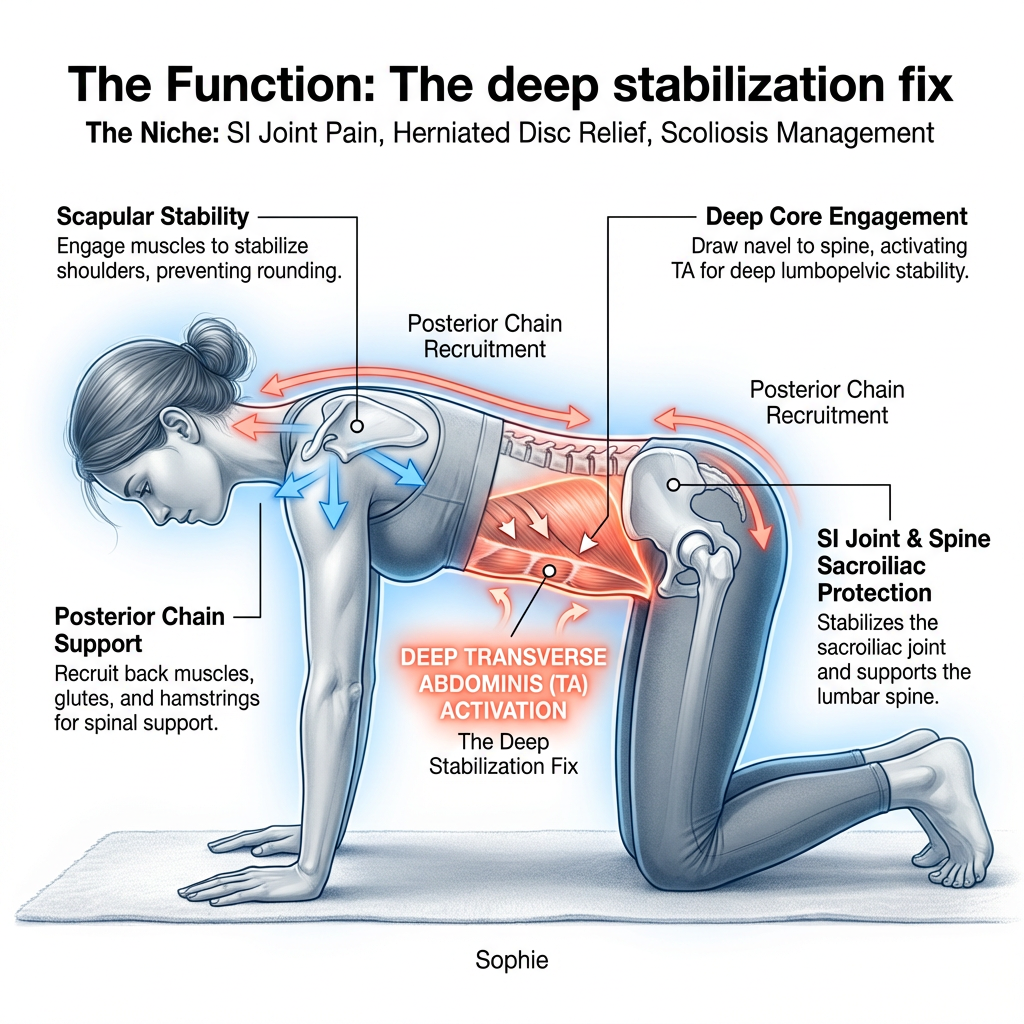
A clinical Pilates programme built for sciatica works on three layers in sequence. First, it decompresses the nerve by restoring neutral spine alignment and unloading the lumbar segments through gentle traction-style movements rather than flexion. Second, it activates the deep stabilising system — transversus abdominis, multifidus, pelvic floor — so the spine no longer relies on tight surface muscles for support. Third, it uses graded neural mobilisation (nerve glides) at the correct intensity, never to the point of provocation, to restore the nerve's natural sliding behaviour through the surrounding tissues.
Phase progression is what separates a clinical Pilates protocol from a generic Pilates class. In a class, every participant does the same movements at the same intensity. In a protocol designed for sciatica, weeks 1–3 deliberately exclude any movement that loads the lumbar spine in flexion. Weeks 3–6 introduce stabilisation work that rebuilds the muscular support the spine has lost. Weeks 6–8 layer in functional patterns — hip hinging, single-leg loading, controlled rotation — that prevent recurrence by teaching the body to handle real-world loading without relapsing.
This is why people who have stretched for years often see meaningful change inside four weeks of a structured Pilates programme. It isn't that stretching is wrong — it's that stretching is one tool, applied in isolation, against a problem that needs sequencing, motor control, and progressive load.
Sessions are 25–35 minutes, three to four times per week. Each one follows the same shape so you build skill, not just sweat.
8-week progressive programme · 36 clinical exercises · Weekly schedules · Recovery tracker
“I'd been living with sciatica for 18 months. Stretching helped temporarily but it always came back. This was finally about decompressing the nerve,...” — David K., London, UK · 80% pain reduction (After 6 weeks)
7-day money-back guarantee · Instant PDF download